

Introduction
Moving from Singapore to Malaysia is a familiar journey for many families, homeowners, expatriates, and business owners. Some are returning to Malaysia after years in Singapore. Others are relocating for work, upgrading to a larger home, moving closer to family, or setting up a new base in Johor Bahru, Kuala Lumpur, Penang, or another Malaysian city.
The distance may seem manageable, especially when compared with an overseas move by sea or air freight. Yet a cross-border relocation is not the same as a local house move. It involves two countries, checkpoint procedures, customs requirements, vehicle scheduling, road conditions, property access, and family arrangements that need to line up at the right time.
This is where many households underestimate the process. They may focus on boxes and furniture, only to realise later that documentation, inventories, special handling, storage, and delivery timing are just as important. A cross-border relocation can quickly become stressful when the moving plan depends on assumptions rather than a proper sequence.
This playbook is designed to help you understand the full moving journey, from early planning to final delivery. It explains the practical details behind customs, packing, transport routes, inventory preparation, family coordination, temporary storage, and the support that professional movers in Singapore can provide.
Gmove Logistics supports families and businesses with packing, dismantling, protective wrapping, disposal, secure storage, and special-item handling. With a clear plan, your cross-border relocation can feel less like a rushed transfer and more like a structured transition into your next chapter.
Why Cross-Border Relocation From Singapore to Malaysia Needs a Proper Playbook
A cross-border relocation involves more moving parts than most people expect. The household is not simply packed, loaded, and delivered to another neighbourhood. Your belongings move through a regulated route where paperwork, checkpoint timing, and transport preparation can affect the entire schedule.
For a local move within Singapore, delays are often limited to lift access, traffic, or building rules. For an international household move, the consequences of poor planning can be wider. Incomplete inventory records may slow down clearance. Poor packing may lead to damage over longer road distances. Late key collection may leave movers waiting at the destination. An underestimation of load size may result in insufficient truck space or unnecessary trips.
A playbook helps prevent these issues by turning the move into a sequence of decisions. What are you bringing? What should be discarded before packing? Which items need dismantling? Which documents should be prepared? Will the destination be ready on the same day? Do you need storage between homes? Are there bulky items that require special handling?
When these questions are answered early, your cross-border relocation becomes easier to manage. Instead of reacting to problems on moving day, you can plan around them before they disrupt the journey.
Key Takeaways
- Moving from Singapore to Malaysia may seem simple because the two countries are close, but a cross-border relocation still involves customs checks, transport coordination, packing standards, and property timing.
- A successful Singapore-to-Malaysia relocation starts with understanding your household volume, destination, access conditions, and move-in timeline before choosing the right transport arrangement.
- A detailed inventory is not just an admin task. It supports customs processing, protects your belongings, and helps movers plan load sequence, packing materials, and vehicle space more accurately.
- Families should plan around school schedules, work commitments, renovation timelines, key collection, and temporary storage needs so that the move does not depend on one perfect moving day.
- Working with experienced movers can make the process calmer because packing, dismantling, protective wrapping, disposal, storage, and special-item handling are managed under one coordinated plan.
Understanding the Realities of Moving Between Singapore and Malaysia
How Regulations and Customs Shape the Moving Journey
The Singapore-Malaysia route requires homeowners to be aware of customs procedures on both sides of the border. Household goods, personal effects, electronics, appliances, and special items may need to be properly declared, especially when transported as part of a formal relocation.
Singapore Customs states that personal shipments and household items are subject to customs requirements when crossing borders, and that household goods entering Malaysia may be inspected by customs authorities. This makes documentation and item visibility important during a cross-border relocation.
The purpose of customs checks is not only to identify commercial goods. Officers may need to understand what is being transported, whether items are used household goods, whether any items are restricted, and whether supporting documents are complete. This is why a clear packing list or inventory is often one of the most useful tools in the moving process.
For homeowners, this means the move should not be treated as a casual van delivery. A cross-border relocation benefits from proper item descriptions, organised packing, and early identification of items that may need closer attention. These can include newer electronics, high-value items, plants, food products, liquids, medications, business equipment, or anything that may fall outside the scope of standard household effects.
The safest approach is to prepare early and avoid guesswork. If an item is unusual, newly purchased, fragile, valuable, or regulated, flag it before packing day. This allows your moving team to advise on whether it should be declared, packed separately, documented, or left out of the shipment.
What Customs Documentation Usually Involves
Documentation can vary based on the type of goods, the owner’s status, and the destination circumstances. However, most moves are easier when families prepare a few essentials in advance. These may include copies of identity documents, proof of residence or destination address, an itemised packing list, and relevant supporting papers for specific items.
A relocation planning checklist should include a section for documentation because paperwork often becomes urgent only when the truck is already packed. By then, correcting missing details can be inconvenient. It is better to gather documents before moving day and ensure that your mover has the information needed to prepare the shipment properly.
For household goods, the inventory should be practical rather than overly complicated. It should clearly identify broad item categories, such as clothes, kitchenware, books, small appliances, furniture, bedding, toys, work equipment, and décor. For high-value or sensitive items, more detailed descriptions may be useful.
This process also protects you. A clear inventory allows you to verify whether everything loaded in Singapore has been delivered in Malaysia. It gives structure to unpacking, helps with insurance claims if needed, and reduces uncertainty when multiple family members are involved.
Cross-Country Moving Requirements You Should Not Overlook
Cross-country moving requirements extend beyond customs clearances. They also include access restrictions, building management rules, parking arrangements, lift usage, loading bay availability, and destination conditions. A condominium in Singapore may have strict move-in hours and lift-padding requirements. A landed home in Malaysia may have narrower access roads, uneven surfaces, or limited space for a large truck to park.
Before moving day, review both properties. At the Singapore address, check whether the movers need to book a lift, submit documents to building management, or follow a specific moving slot. At the Malaysia address, confirm whether the truck can reach the property, whether there is space for unloading, and whether guards or management need advance notice.
These details may sound minor, but they affect manpower, vehicle size, unloading time, and safety. A cross-border relocation is smoother when both ends of the journey are prepared, not just the departure point.
Timelines, Transport Routes, and What They Mean for Your Move
Understanding the Singapore-Malaysia Overland Route
Most household moves from Singapore to Malaysia use overland transport. This makes the route relatively direct, especially for destinations in Johor Bahru and nearby areas. However, direct does not always mean predictable. Checkpoint congestion, peak-hour traffic, school holiday movement, festive travel, rain, and road conditions can all affect the schedule.
For moves to Johor Bahru, same-day completion may be possible when the load is manageable, documents are prepared, and access at both homes is smooth.
For longer distances, such as moving from Singapore to Kuala Lumpur, the move typically requires more careful scheduling because road travel, rest time, unloading, and property readiness all need to be considered.
A cross-border relocation should therefore be planned around realistic transport windows rather than ideal travel times. This is especially important when families are also travelling separately by car, coach, or flight. Your household goods, family members, keys, and access to the destination should be coordinated so that nobody is left waiting unnecessarily.
Choosing the Right Transport Arrangement
The right transport arrangement depends on the size of your move, urgency, budget, and destination. A small shipment of personal belongings may not need the same vehicle arrangement as a full family home. Moving from Singapore to Penang may be planned differently from a full household relocation to Johor Bahru.
Some households may prefer a dedicated truck because it offers more control over timing and reduces handling between stops. Others may explore shared or consolidated arrangements when the load is smaller and the timeline is more flexible. The best option depends on whether your priority is speed, cost control, simplicity, or direct delivery.
For families moving with children, pets, elderly parents, or work deadlines, timing control can matter as much as price. For singles or students moving a smaller volume, flexibility may be more practical. A good moving plan does not simply ask, “What is the cheapest option?” It asks, “Which option fits the way this household needs to move?”
This is also where house-moving services in Singapore can support the planning stage. By assessing your inventory, destination, and timeline, movers can recommend a transport setup that suits the actual conditions of the move.
Building a Realistic Moving Timeline
A practical timeline should begin weeks before the actual moving date. The earlier stage should focus on deciding what to keep, sell, donate, dispose of, or store. This reduces unnecessary load volume and helps you avoid paying to transport items you no longer need.
Next, confirm your destination timeline. Will the Malaysian property be ready? Are renovations complete? Is the handover confirmed? Are utilities active? Will you need time to clean the home before furniture arrives? These questions matter because a cross-border relocation becomes harder when the destination is not ready to receive goods.
As moving day approaches, finalise packing, dismantling, inventory checks, documents, and access arrangements. Keep essential items with you, including passports, identification, medication, chargers, important documents, school materials, work laptops, and overnight clothes.
After delivery, allow time for unpacking, furniture placement, appliance checks, and reassembly. Avoid scheduling too many commitments immediately after move-in. Even when the transport goes well, settling into a new country, city, or neighbourhood takes time.
Packing, Inventory, and Load Management for a Safer Move
Why Packing Standards Matter More for Cross-Border Moves
Packing is one of the biggest differences between a simple local move and a cross-border relocation. Items are not just travelling a few streets away. They may be handled across longer distances, loaded into a truck for extended road travel, inspected, unloaded, and moved into a very different property layout.
Fragile items need cushioning and box discipline. Furniture needs protective wrapping. Appliances should be cleaned, dried, and prepared properly. Wardrobes, bed frames, tables, and bulky pieces may need to be dismantled to travel safely and fit through access points.
Good packing also makes customs and unloading more efficient. Boxes that are clearly labelled by room and category are easier to identify. Items that are grouped logically reduce confusion when checking the inventory. Heavy items should not be placed loosely with fragile pieces. Liquids should be sealed separately. Important documents should never be packed deep inside the shipment.
Gmove Logistics uses appropriate packing materials and methods to safeguard belongings under varying road conditions. For homeowners, this reduces the risk of scratches, impact damage, shifting loads, and rushed handling during the move.
Creating an Inventory That Actually Helps
A useful inventory does more than list boxes. It gives your move structure. Start by grouping items room by room: master bedroom, children’s rooms, kitchen, living room, study, storage room, balcony, and service yard. Then identify item types within each group.
For example, your kitchen inventory might include cookware, plates, utensils, dry goods, small appliances, and glassware. Your bedroom inventory might include clothes, bedding, books, bedside lamps, and personal items. For large furniture, list items individually: queen bed frame, dining table, office chair, TV console, refrigerator, washing machine, and wardrobe.
This level of detail supports cross-border logistics planning by helping estimate truck space, manpower, packing materials, and loading sequence. It also helps you decide what to travel first, what should be accessible upon arrival, and what may be better placed in storage.
For high-value belongings, take photos before packing. This is useful for personal records and may support insurance documentation. Keep serial numbers or receipts for selected electronics where relevant. Avoid mixing valuables into general cartons without clear labelling and tracking.
Load Management and Safe Transport
Load management is the hidden part of moving that many homeowners do not see. A well-packed box can still be damaged if the truck is loaded poorly. Heavy furniture, cartons, appliances, and fragile items need to be positioned to minimise movement during the journey.
Weight distribution matters. If a truck is loaded unevenly, items may shift during braking, turning, or uneven road sections. Tall items need support. Fragile boxes should not bear weight. Dismantled furniture should be bundled and protected. Mattresses and upholstered furniture should be wrapped to reduce exposure to dust and moisture.
A cross-border relocation also involves stops at checkpoints and possible waiting time, so the load should remain secure even when the vehicle is stationary or moving slowly in traffic. This is why proper stacking, securing, and protective wrapping are not optional details. They are part of safe transport.
Professional movers understand how to sequence the load so that items needed first at the destination can be unloaded efficiently. This is especially helpful when moving into a multi-storey home, a condominium, or a temporary residence.
Planning a Smooth and Stress-Free Cross-Border Experience
Start With a Pre-Move Assessment
A pre-move assessment helps identify problems before moving day. This may include estimating the volume of belongings, reviewing bulky items, checking lift access, assessing stairways, identifying fragile pieces, and understanding special handling requirements.
During the assessment, be honest about everything that needs to move. Store rooms, cupboards, service yards, and hidden corners often contain more items than expected. Underestimating volume can affect vehicle size, manpower, packing time, and transport cost.
This is also the right time to discuss disposal. Not every item deserves to cross the border. Old furniture, damaged appliances, expired products, excess documents, and unused household goods can add unnecessary weight and clutter. Disposal support can help you clear these items responsibly before the move.
A cross-border relocation is easier when the home has already been edited down to what truly needs to travel.
Protecting Belongings Before, During, and After the Journey
Protection begins before the first box is sealed. Fragile items should be separated, wrapped, and cushioned. Furniture corners should be protected. Glass panels, mirrors, artwork, and display pieces should be flagged early. Electronics should be packed with care, ideally with original packaging where available.
During the move, protection depends on handling and loading. Movers should understand which boxes are fragile, which items cannot be stacked, and which pieces require two-person handling. Dismantled parts should be kept together so that reassembly is straightforward.
After delivery, inspect major items before signing off. Check visible surfaces, appliances, glass, and special items. Unpack essentials first, then move gradually through the rest of the home. This reduces the feeling of being overwhelmed and helps the household settle in a more organised way.
Gmove Logistics plans each stage of handling so belongings travel securely across both countries, from protective wrapping to careful loading, unloading, and placement.
Managing Special Items and High-Risk Belongings
Some belongings need more planning than ordinary cartons. Pianos, large mirrors, marble tables, gym equipment, aquariums, safes, designer furniture, antiques, large appliances, and oversized wardrobes can all affect the moving plan.
These items may require additional manpower, dismantling, customised wrapping, lifting techniques, or special placement inside the truck. For cross-border journeys, they should be identified early so movers can prepare the right equipment and allocate enough time.
High-risk items also deserve a conversation about insurance. While professional handling reduces risk, no move is completely free from unforeseen incidents. Insurance offers additional assurance, especially for expensive, fragile, or sentimental items travelling over a longer distance.
This is especially relevant for an international household move where belongings may travel through traffic, checkpoints, and long road routes before reaching the destination.
Coordinating Family, Documents, and Property Timelines
Aligning the Move With Real Life
A move is not only a logistics project. It affects school routines, work schedules, elderly family members, pets, domestic helpers, renovation contractors, cleaners, landlords, agents, and building managers.
Families often need to decide whether everyone travels together or separately. Children may need familiar items kept aside for comfort. Elderly family members may need medication, mobility aids, and rest arrangements planned carefully. Working adults may need laptops, chargers, and documents accessible immediately after arrival.
A cross-border relocation becomes smoother when these human details are planned alongside the transport arrangements. The goal is not only to move furniture. It is to help the household function during the transition.
Property Handover, Renovation, and Storage Gaps
Property timing is one of the most common sources of stress. The Singapore home may need to be vacated before the home in Malaysia is ready. Renovation works may be delayed. Key collection may shift. Cleaning may take longer than expected. Utility activation may not be complete.
When the moving schedule depends on one exact handover date, even a small delay can create pressure. Temporary storage provides a useful buffer. It allows belongings to be collected and stored safely until the new property is ready.
Gmove Logistics supports this stage with warehouse storage that offers 24/7 security, full-time surveillance, and flexible short- and long-term space. This is useful for families who need to move out first, wait until the renovation is complete, or stagger delivery across different dates.
Storage can also support downsizing. If you are unsure whether certain furniture will fit in the new home, temporarily storing selected items gives you time to decide after you have seen the space in use.
Destination-Specific Planning: Johor Bahru, Kuala Lumpur, and Penang
Different Malaysian destinations require different planning assumptions. Moving from Singapore to Johor Bahru is usually more straightforward because of the shorter distance. However, checkpoint timing and property access still matter. Same-day delivery may be realistic for suitable moves, but it should still be planned with traffic and customs checks in mind.
Moving from Singapore to Kuala Lumpur requires a longer road journey and more careful coordination. Families should factor in travel time, driver rest, unloading windows, and destination building rules. If you are moving into a condominium, check with management about moving deposits, lift bookings, and permitted hours.
Moving from Singapore to Penang involves an even longer route, so packing standards, load security, and realistic delivery expectations become especially important. Households should avoid last-minute changes because adjustments can affect manpower, transport scheduling, and arrival timing.
A cross-border relocation should always be planned according to the destination, not just the departure address.
Common Mistakes That Make Cross-Border Moves Harder
Packing Too Late
Many households start packing only when the moving date feels close. This leads to rushed decisions, poorly labelled boxes, mixed fragile and heavy items, and unnecessary clutter being transported. Start with non-essential items weeks in advance, then leave daily essentials until the final stage.
Treating Customs as a Last-Minute Issue
Customs should be considered from the start. A complete inventory, clear item descriptions, and early identification of special goods can reduce avoidable delays. Do not assume that everything can be handled casually at the checkpoint.
Underestimating Volume
Homes often contain more than expected. Cabinets, storerooms, kitchen cupboards, children’s items, tools, and balcony furniture can significantly increase the load. A volume estimate should be based on a full review, not a quick glance around the living room.
Forgetting Destination Access
The Malaysian address may have different access conditions from the Singapore home. Confirm parking, lift use, guardhouse procedures, road width, and unloading space. This is especially important for larger trucks or bulky furniture.
Not Planning for the First Night
Keep first-night essentials with you. These may include clothes, toiletries, medication, chargers, documents, basic kitchen items, bedding, snacks, and items for children or pets. Your first night should not depend on finding one specific box in a full shipment.
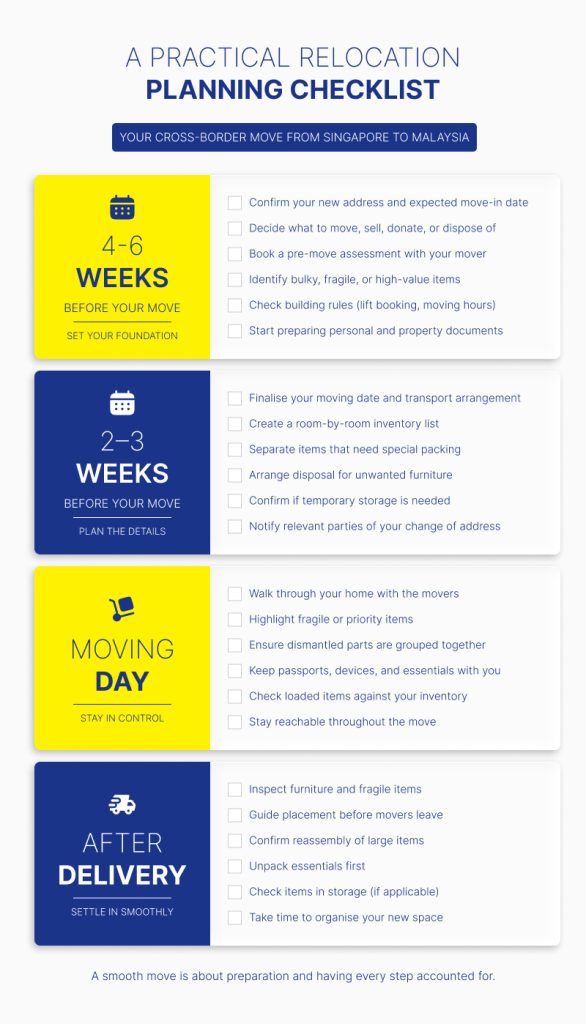
A Practical Relocation Planning Checklist
Use this relocation checklist as a working guide before moving day.
Four to Six Weeks Before the Move
- Confirm your destination address and expected handover date.
- Decide what to move, sell, donate, dispose of, or store.
- Arrange a pre-move assessment with your mover.
- Identify bulky, fragile, valuable, or unusual items.
- Check building management rules at both properties.
- Start gathering identity documents and property-related paperwork.
Two to Three Weeks Before the Move
- Finalise your moving date and transport plan.
- Prepare a room-by-room inventory.
- Separate items that need special packing.
- Confirm whether storage is needed.
- Arrange disposal for unwanted furniture or appliances.
- Inform relevant parties about your change of address.
One Week Before the Move
- Pack non-essential items.
- Label boxes by room and category.
- Keep important documents separate.
- Prepare essentials for your first few days.
- Confirm lift bookings, parking, and access arrangements.
- Review customs-related details with your mover.
Moving Day
- Walk through the home with the moving team.
- Point out fragile, valuable, or priority items.
- Check that dismantled parts are grouped together.
- Keep passports, medication, devices, and documents with you.
- Review the loaded items against your inventory.
- Stay contactable throughout the journey.
After Delivery
- Check major furniture and fragile items.
- Guide movers on placement where possible.
- Confirm reassembly requirements.
- Unpack essentials first.
- Review stored items if anything remains in the warehouse storage.
- Update your household records and gradually settle into the new property.
Frequently Asked Questions
1. What documents are required for household goods to clear customs?
Clearance requirements can vary, but households should usually prepare item inventories, identity documents, proof of residence or destination address, and supporting records for specific goods where needed. Gmove Logistics can help organise the relevant information so that documentation is not left until moving day.
2. Can certain household items face restrictions when crossing the border?
Yes. Some goods may require permits, declarations, or closer review, especially if they are new, high-value, plant-related, food-related, liquid-based, commercial in nature, or classified as controlled materials. These items should be flagged early so your mover can advise on the next steps.
3. How long does the overall move from Singapore to Malaysia usually take?
Timelines depend on load size, customs clearance, transport route, and destination readiness. Moves to Johor Bahru may be completed within the same day when conditions are suitable, while longer-distance relocations to other parts of Malaysia are usually planned with wider delivery windows.
4. What happens if the keys to the new property are delayed?
If keys are delayed, belongings can be placed in temporary storage until access is available. Gmove Logistics’ secure warehouse facility provides round-the-clock surveillance and flexible storage options for both short-term and long-term needs.
5. Is insurance recommended for cross-border household moves?
Insurance is recommended for additional assurance, especially for fragile, sentimental, or high-value items. Coverage is typically arranged through third-party insurers and can provide financial protection in the event of accidental damage or unforeseen incidents.
6. Should I use movers or manage the move myself?
A self-managed move may suit very small loads, but a full cross-border relocation is usually easier with professional support. Movers can help with packing, inventory, customs preparation, loading, route coordination, dismantling, storage, and delivery. This reduces the number of moving parts you need to handle on your own.
Moving to Malaysia With Gmove Logistics
A cross-border relocation becomes far more manageable when every stage is planned with care. From customs preparation and inventory checks to packing, transport coordination, and delivery timing, each detail helps make your move from Singapore to Malaysia feel structured rather than overwhelming.
Gmove Logistics supports households with practical moving solutions tailored to the realities of cross-border moves. Our team provides packing, dismantling, protective wrapping, disposal, special-item handling, and secure warehouse storage, giving you the flexibility to move at a pace that suits your property timeline and family arrangements.
Whether you are relocating to Johor Bahru, Kuala Lumpur, Penang, or another part of Malaysia, Gmove Logistics helps you prepare your belongings, manage the moving process, and reduce unnecessary stress along the way.
Reach out to us today if you are planning a cross-border relocation to discuss your move and explore how our team can support a safer, smoother, and more organised transition into your new home in Malaysia.

