


Introduction
From our experience supporting household moves across Singapore, moving burnout rarely begins with one major problem. It usually builds through many small responsibilities that keep piling up. Packing anxiety follows because every unfinished room starts to feel like proof that time is running out.
Have you started thinking about your move while eating dinner, answering work messages or trying to fall asleep?
We have seen this happen to many homeowners. At first, the move feels manageable. You buy a few cartons, clear one cabinet and tell yourself that the rest can be handled over the next few weekends.
Then the list grows.
There are utilities to transfer, lift bookings to confirm, furniture measurements to check and family members to coordinate. Before long, the move is taking up your evenings, weekends and mental space.
So, how do you know when you are simply busy and when you are taking on too much?
Key Takeaways
- Moving burnout often develops when packing, administrative tasks, work and family responsibilities compete for the same limited time.
- Packing anxiety can come from decision fatigue, unclear priorities and the pressure to remember every detail.
- A DIY move may still be manageable when the household is small, the timeline is realistic and heavier tasks are delegated early.
- Poor sleep, irritability, unfinished rooms, last-minute packing and difficulty concentrating are common warning signs.
- Professional support can reduce moving burnout by taking over packing, dismantling, lifting, transport, disposal and storage.
Signs Your Anxiety Is Escalating
Anxiety can sometimes manifest as avoidance.
You may walk into a cluttered room, feel unsure where to begin and decide to deal with it later. You may spend an hour reorganising one drawer because starting on the larger task feels too difficult.
From the moves we have supported, common warning signs include:
- Feeling tired even after sleeping
- Becoming unusually irritable
- Struggling to focus at work
- Avoiding certain rooms
- Losing track of deadlines or important belongings
- Packing late into the night repeatedly
- Feeling physically sore from lifting and bending
- Becoming stuck over small decisions
- Skipping meals, routines or rest
When several signs appear together, moving burnout may already be affecting how efficiently you work.
Why Moving House Can Become So Overwhelming
Most people think of moving as a physical task. Pack the boxes, load the vehicle and bring everything to the new home.
In practice, the boxes are only one part of the job.
During a typical move, homeowners may also need to:
- Arrange utility and internet transfers
- Coordinate renovation or cleaning schedules
- Book service lifts and loading bays
- Decide what to keep, donate, store or dispose of
- Update addresses and complete handover paperwork
- Manage children, elderly family members or pets
- Continue working full-time
- Plan where furniture and essentials will go
Are you trying to manage several of these at once?
This is where moving house stress can become difficult to contain. Each task may seem small on its own, but together they create a continuous mental load.
We often meet homeowners who are not only tired from packing. They are tired from remembering, checking, deciding and chasing updates all day.
That constant pressure is one of the clearest pathways to moving burnout.
How Long Does Packing and Moving Really Take?
One common cause of packing overwhelm is underestimating how long the preparation will take.
A home can contain hundreds or even thousands of individual items spread across wardrobes, kitchen cabinets, storerooms, bookshelves and hidden storage spaces. Even an organised household may need several weeks to sort, declutter and pack properly.
The physical move may take one day, but preparation can include:
- Buying and assembling cartons
- Wrapping fragile belongings
- Dismantling furniture
- Labelling boxes
- Arranging disposal
- Confirming access requirements
- Cleaning both properties
- Preparing essential items for moving day
In our experience, moving burnout often appears when these tasks are compressed into a few late nights and weekends.
Ask yourself this: if one evening is lost to overtime, childcare or illness, does your entire packing schedule collapse?
If the answer is yes, your timeline probably needs more breathing room.
The Mental Load of Keeping Track of Everything
Some of the hardest work during a move is invisible.
You may be tracking which boxes are packed, what still needs to be bought, which items are fragile, what must remain accessible and whether key appointments have been confirmed.
Even when you stop packing for the night, your mind may continue running through the list.
This form of relocation anxiety can follow you into work, meals and sleep.
We have observed that homeowners often become the household’s “control tower”. Everyone asks them where things are, what happens next and whether a particular task has been completed.
When one person carries most of that responsibility, moving burnout can develop before the heavy lifting even starts.
A shared checklist, clear room assignments and one consistent labelling system can reduce this strain before it develops into moving burnout.
Is a DIY Move Still Manageable?
A DIY move can work for some households. A smaller home, fewer bulky items, a short distance and a generous timeline can make self-moving practical.
However, it helps to assess the full workload rather than focusing only on transport.
Ask yourself:
- How many rooms need to be packed?
- Are there large appliances or heavy furniture?
- Will anything require dismantling?
- Are there condominium access restrictions?
- Do you have enough people available?
- Can everyone lift safely?
- Is there time to recover if packing falls behind?
In Singapore, service lift bookings, loading limits, parking access and wet weather can also affect timing.
The goal is not to avoid doing anything yourself. It is to prevent a manageable plan from turning into moving burnout because too much depends on you.
How to Make a DIY Move More Manageable
A controlled DIY move usually starts earlier than people expect.
Begin with items you will not need before moving day, such as seasonal clothing, display pieces, spare linen, and rarely used kitchenware. Pack one room at a time and complete it as far as possible before moving elsewhere.
Create a Timeline With Buffer Days
Do not schedule every evening as a packing night. Leave room for work delays, family commitments and unexpected problems.
A plan that only works when nothing goes wrong is not a realistic plan.
Separate Decisions From Physical Work
Use one session to decide what stays, goes or needs disposal. Use another session to pack.
Mixing both processes can increase packing overwhelm because every object demands a new decision before you can make progress.
Label for the New Home
Write the destination room and a short description on each carton.
“Kitchen: daily cookware” is much more useful than “kitchen stuff”, especially when you are trying to find something shortly after arriving.
Protect Your Essentials
Keep medication, documents, chargers, toiletries, basic tools and a change of clothes in a separate bag.
Do not place this bag with the general cartons. Keep it with you or clearly mark it for immediate access.
Get Help for Heavy Items
Beds, wardrobes, refrigerators and large tables may require dismantling, protective wrapping and route planning.
Trying to work out how to move these items on the day itself can quickly add to moving burnout.
What Can You Delegate?
Many homeowners assume that asking for help means handing over the entire move. It does not.
You can choose support based on the parts creating the most pressure.
For example, movers and packers in Singapore may assist with full or partial packing, fragile-item protection, furniture dismantling, loading and transport. You may still prefer to pack personal documents, valuables or sentimental items yourself.
Other tasks that can often be delegated include:
- Mattress and sofa wrapping
- Appliance handling
- Disposal of unwanted furniture
- Temporary storage
- Furniture reassembly
- Carton labelling
- Loading and unloading
This division can ease moving burnout because you retain control over important decisions while reducing the most time-consuming physical work.
When Is It Time to Call Professional Movers?
Many people wait until the final week to ask for help. By then, the household may already be exhausted.
Consider professional support when:
- Several rooms remain untouched close to moving day
- Progress has slowed despite long hours
- The move is affecting sleep, work or family routines
- Arguments about packing are becoming frequent
- Heavy items cannot be moved safely
- Access bookings and timelines are difficult to coordinate
- You are repeatedly losing track of belongings or deadlines
A reliable moving service in Singapore can turn a growing list of unfinished tasks into a clearer sequence of work. Experienced teams know how to protect furniture, organise loading and work within access restrictions.
This practical support can prevent moving burnout from escalating during the final stretch.
How Professional Support Helped One Family Reduce Packing Anxiety
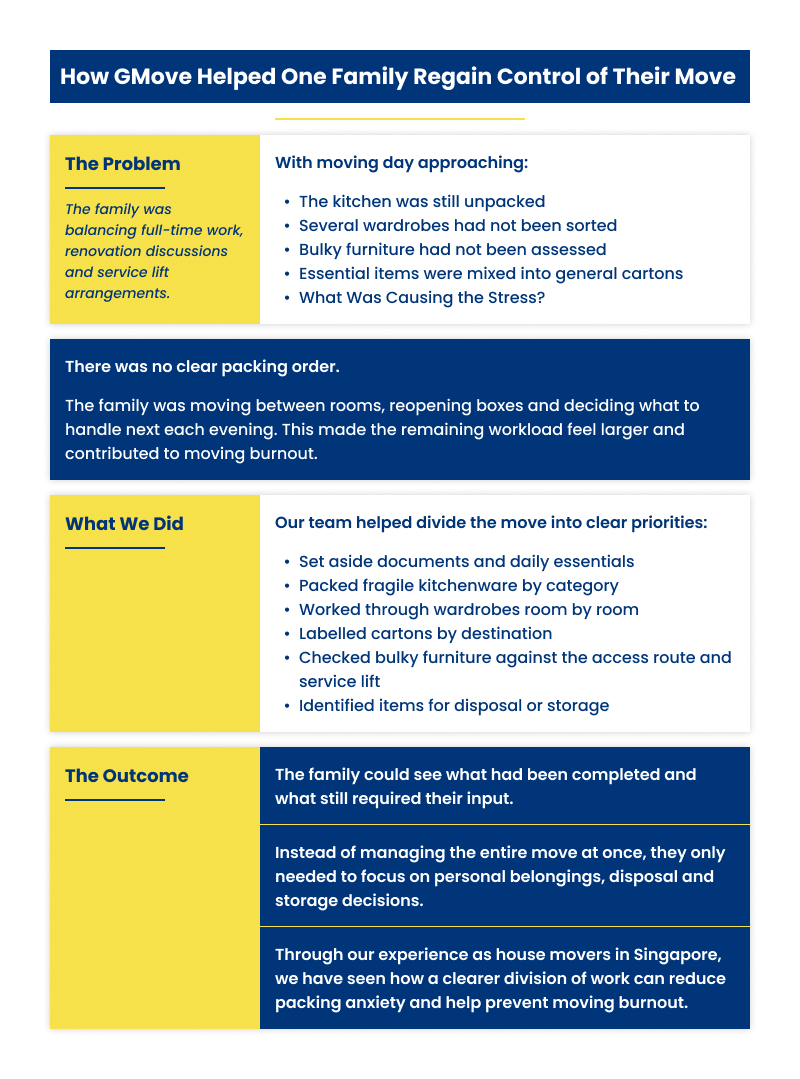
In one household move we supported, the homeowners had planned to pack gradually after work and over the weekends. However, renovation discussions, family responsibilities and service lift arrangements took up more time than they expected.
With moving day approaching, the kitchen was still unpacked, several wardrobes had not been sorted, and the family was unsure which bulky furniture needed to be dismantled.
The main source of anxiety was the lack of a clear order. The homeowners were moving between rooms, packing whatever seemed most urgent and repeatedly reopening cartons to look for items they still needed.
How We Helped
Our team first helped break the remaining work into priorities. Daily essentials and important documents were separated for personal handling, while our packers started with the rooms and items that could be completed without disrupting the family’s routine. Fragile kitchenware was packed and labelled by category, wardrobes were handled room by room and larger furniture was checked in advance against the access route and service lift dimensions.
This gave the homeowners a structured picture of what had already been completed and what still required their input. Instead of worrying about the entire home at once, they only needed to make decisions on disposal, storage and personal belongings.
Through our work as house movers in Singapore, we have found that this shift can make a significant difference. In this case, the unfinished rooms were brought under control, the risk of packing essential items too early was reduced, and the family no longer had to spend each evening deciding what to tackle next.
The move still required their involvement, but the most immediate source of moving burnout was removed: they were no longer trying to plan, pack and coordinate every part of the relocation at the same time.
Storage and Disposal Can Create Breathing Room
You may be downsizing, waiting for renovation work to finish or feeling unsure about certain furniture. Forcing every decision before moving day can increase relocation anxiety and delay progress.
Temporary storage gives you time to organise the new space before bringing in non-essential items.
Disposal support can also remove damaged furniture, unused appliances and bulky belongings that no longer fit your needs.
Creating physical space often creates mental space too, which can help slow moving burnout.
How We Help Homeowners Manage the Move
At GMove Logistics, our role is not simply to move boxes.
We help plan the work sequence, protect furniture, dismantle suitable items, organise cartons, manage loading and coordinate transport. Where required, we can also assist with disposal and storage arrangements.
As professional movers in Singapore, we are used to working around service lift bookings, condominium access rules, narrow corridors and household timelines.
This experience helps us identify practical issues before they cause delays.
Some homeowners need full packing support. Others only need help with bulky furniture, protective wrapping and transport. The right arrangement should reflect what you can reasonably manage, rather than what you feel you ought to handle alone.
Recognising moving burnout early gives you more options and a better chance of protecting your energy before moving day.
Frequently Asked Questions
Is Packing Anxiety Normal During a House Move?
Yes. Packing anxiety is common because a move combines physical work, decision-making, deadlines and emotional change.
It becomes a concern when it repeatedly affects your sleep, work, relationships or ability to complete basic tasks.
What Is Moving Burnout?
Moving burnout is the physical and mental exhaustion that develops when relocation demands exceed the time, energy or support available.
It may show up as fatigue, irritability, poor concentration, avoidance and last-minute panic packing.
How Early Should I Start Packing?
For most households, starting several weeks ahead is more realistic than relying on the final few weekends.
Begin with non-essential items, then work towards daily-use belongings as moving day approaches.
Is Hiring Movers Worth It If I Can Do Some Tasks Myself?
It can be. You do not need to outsource the entire move.
Many homeowners pack personal items themselves while leaving furniture dismantling, heavy lifting, wrapping and transport to professionals. This can reduce moving burnout without removing your control over the process.
Reduce Moving Burnout With GMove Logistics
Moving house should not require you to sacrifice every evening, lose sleep or carry the entire household plan in your head.
From our experience, moving burnout is usually a sign that the workload, timeline or division of responsibility needs to change. Starting earlier, simplifying decisions and delegating the right tasks can make the process feel far more manageable.
At GMove Logistics, we provide practical support based on the scale of your move and the areas causing the most pressure. Whether you need packing, furniture handling, transport, disposal or storage assistance, we can help reduce the execution-heavy work and keep the move progressing in a clearer order.
Is your move already taking over more of your life than expected? Contact us to discuss the support your household needs before moving burnout builds further.

