


Key Takeaways
- The office relocation process works best when it is treated as an operational project, not simply a moving-day task.
- We recommend confirming building access, freight lift bookings, loading arrangements, and permitted moving hours before your packing schedule is finalised.
- If your team is short on time, experienced movers and packers in Singapore can take on execution-heavy work while your staff focus on business decisions.
- IT migration, confidential records, workstation labelling, and department sequencing should each have a clear owner rather than sitting under one general moving checklist.
Introduction
When business owners first speak to us about moving offices, the questions are usually practical: “How long will it take?”, “Can we do it over the weekend?”, “Do our employees need to pack everything?” or “Can the workstations be dismantled and reassembled?”
In our experience, these questions point to a real challenge. The office relocation process becomes difficult when building access, IT, furniture, staff, contractors, and business operations all have to move on the same timeline.
At GMove, we have supported businesses with different office sizes, layouts, and operational requirements. Over time, we have noticed the same pressure points appearing repeatedly. Here are the lessons we most often share with clients before the move begins.
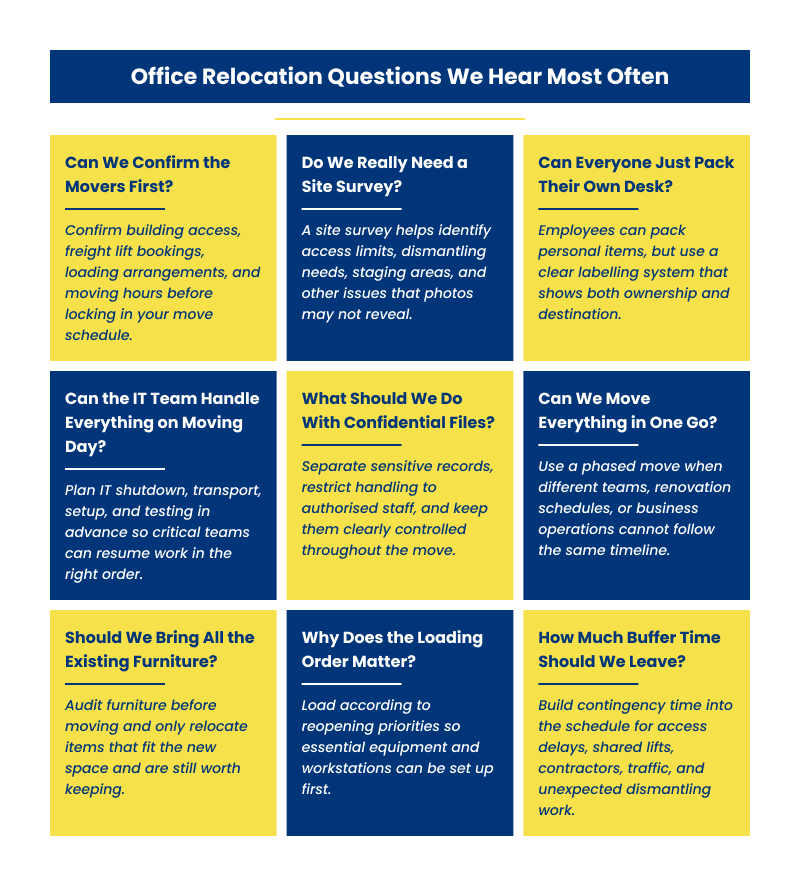
Lesson 1: “Confirm the Movers First or Sort Building Access?”
We recommend the latter.
Before finalising the office relocation process, check the rules at both your current and new premises. Commercial buildings may have specific requirements for freight lifts, loading bays, vendor registration, floor protection, security access, and permitted moving hours.
In fact, one of the first things we look at during the office relocation process is whether the proposed moving schedule actually matches the access available at both buildings.
One client, for example, had already planned staff packing around a weekend move. During coordination, the available freight-lift window turned out to be narrower than expected. The packing, dismantling, loading, and delivery sequence had to be adjusted around the approved access period.
This is why we treat building coordination as part of office transition planning, not as paperwork to leave until the final week.
Lesson 2: “Do We Really Need a Site Survey?”
Clients sometimes assume that photos and a furniture list are enough. They are helpful, but they do not always show the practical constraints that shape the office relocation process.
For larger or more complex moves, we recommend a site assessment. GMove uses site surveys to understand the volume of items, access conditions, dismantling requirements, and other factors that affect the move and quotation.
During a walkthrough, we may check whether large tables can turn through corridors, how far the freight lift is from the office, where packed cartons can be staged, and which items need extra handling.
That is why an office relocation checklist based only on item quantities can be incomplete. The route those items need to travel matters too.
Lesson 3: “Can Everyone Just Pack Their Own Desk?”
Sometimes, yes. We often recommend that employees pack personal belongings while the business decides how shared files, equipment, stationery, and furniture should be handled.
The mistake is assuming that this alone counts as preparations before moving office.
We have seen cartons labelled only with employee names even though the seating plan at the new office had changed. The movers knew who owned each carton, but not where it should go.
For a smoother office relocation process, we recommend labels that identify both ownership and destination. A simple format such as “Finance – WS12 – Zone B” is much more useful than a name alone.
If you need more hands-on support, our office moving services can include packing materials, packing and unpacking support, furniture handling, and related moving requirements according to the agreed scope.
Lesson 4: “Can the IT Team Handle Everything on Moving Day?”
We usually advise against leaving the whole technology transition to moving day.
The physical movement of computers and equipment is only one part of the office relocation process. Your IT team may also need to manage backups, shutdown timing, internet readiness, cable mapping, workstation setup, and testing.
A request we hear regularly is, “Please move this team first because they need to be operational on Monday.” That changes the loading sequence immediately. Their equipment cannot be buried behind furniture that will only be needed later.
In a larger workplace relocation process, we recommend deciding which teams and systems are operationally critical before packing starts. The loading and unloading order should reflect your reopening priorities.
Lesson 5: “What Should We Do With Confidential Files?”
This question often comes up only when teams start opening cabinets and storerooms.
We recommend deciding early which files should move, which require authorised supervision, and which records are no longer needed. Organisations in Singapore are expected to protect personal data with reasonable security arrangements and dispose of it properly when it is no longer required for legal or business purposes.
Within the office relocation process, we suggest keeping confidential cartons separate, avoiding labels that expose sensitive contents, assigning authorised staff to oversee priority records, and preventing documents from being left unattended in shared staging areas.
We often find that moving office also exposes how much archived material a business has accumulated. Instead of automatically moving every cabinet, use the relocation as a decision point.
Lesson 6: “Can We Move Everything in One Go?”
Clients often ask this because one large movement sounds simpler. Sometimes it is. In other cases, a phased office relocation process is more practical.
One department may need to work until Friday evening while another can pack earlier. Part of the new office may still be under renovation. Some furniture may need temporary storage because handover dates do not align.
When we hear these constraints, we recommend planning around business continuity rather than forcing every department onto the same schedule.
This is especially relevant when moving office in Singapore between buildings with different access conditions. A staged move can help prioritise essential teams and prevent the destination from filling with items before the right areas are ready.
Lesson 7: “Should We Bring All the Existing Furniture?”
Before the office relocation process reaches the packing stage, we recommend auditing what is actually worth moving.
One client had several storage cabinets that initially appeared reusable. Once their dimensions were compared with the new layout, it became clear that moving them would simply create another problem at the destination. The team separated what would be retained from what needed disposal before the main move.
We see similar decisions with oversized tables, surplus chairs, damaged furniture, obsolete electronics, and equipment with no allocated position in the new office.
GMove offers storage and disposal as add-on services, which can help when not everything is travelling directly from one workplace to another.
Lesson 8: “Why Does the Loading Order Matter?”
Because unloading order affects how quickly your new office becomes usable.
If the items needed first are buried behind lower-priority furniture, the office relocation process can slow down at the destination. This is why we recommend planning the office relocation process backwards from what needs to be ready first.
Ask what matters most on reopening: reception, network equipment, customer-service workstations, meeting rooms, or another operational area. That priority should influence how items are packed, loaded, and unloaded.
For larger moves, we also recommend one authorised contact at the old office and another at the new office. This reduces conflicting instructions when questions arise.
Lesson 9: “How Much Buffer Time Should We Leave?”
More than zero.
A weak office relocation process often has a schedule where every task depends on the previous one finishing exactly on time. Commercial moves can be affected by shared loading bays, lift access, contractors, security procedures, weather, traffic, or unexpected dismantling work.
We recommend adding buffer time around the parts of the move that sit outside your direct control.
If employees are expected to carry equipment or furniture themselves, workplace safety should also be considered. Singapore guidance notes that manual-handling practices should take the load and nature of the task into account, rather than relying on one universal safe lifting weight.
Where heavy, awkward, bulky, or fragile items are involved, working with professional movers in Singapore helps businesses keep those tasks with people accustomed to handling moving work.
What We Ask Before We Plan Your Move
A moving date is useful, but it is not yet a plan. To build a workable office relocation process, we usually ask:
- What are the access rules at both buildings?
- Has the freight lift been booked?
- What is moving, staying, going into storage, or being disposed of?
- Which furniture needs dismantling?
- Are there bulky, fragile, or specialised items?
- Who is responsible for IT shutdown and setup?
- Which teams need to resume work first?
- Will employees pack their own workstations?
- Are there confidential records requiring controlled handling?
- Will the move happen in one phase or several?
These questions turn a moving date into an operating plan.
The Office Relocation Checklist We Walk Through With Our Clients
Before we finalise an office relocation process, we usually work through the following checklist with our clients. It helps us identify potential issues early so there are fewer surprises on moving day.
| Task | Completed |
| Confirm your moving date and handover dates for both offices | |
| Reserve freight lifts, loading bays, and obtain any required building approvals | |
| Appoint one internal relocation coordinator to communicate with movers and staff | |
| Complete an inventory of furniture, equipment, and archived documents | |
| Decide which items will be moved, stored, disposed of, or replaced | |
| Confirm which furniture requires dismantling and reassembly | |
| Schedule internet activation, server migration, and other IT works | |
| Back up important business data before the move | |
| Label cartons by department, workstation, and destination area | |
| Separate confidential documents and assign authorised personnel to oversee them | |
| Inform employees of packing responsibilities and moving timelines | |
| Notify clients, vendors, and service providers of your relocation where required | |
| Prepare an essentials box with items needed immediately after arrival, such as access cards, keys, chargers, stationery, and important documents | |
| Conduct a final walkthrough of the existing office before handover | |
| Test internet, phones, workstations, and shared facilities before resuming normal operations |
We encourage clients to complete this checklist at least one to two weeks before the main move. Doing so gives enough time to resolve issues such as missing building approvals, incomplete labelling, furniture that needs dismantling, or IT arrangements that are still pending, instead of discovering them during the relocation itself.
Frequently Asked Questions
How early should we start the office relocation process?
We recommend starting as soon as your premises, handover dates, and broad move window are known. GMove generally advises booking movers around two to three weeks in advance where possible, although a larger or more complex office relocation process may require more preparation.
Who should manage the office relocation process internally?
We recommend appointing one project lead who can coordinate with management, employees, IT, building management, contractors, and movers. Department representatives can help, but one central contact reduces conflicting instructions.
Can we keep operating during the move?
Often, yes. Businesses may use after-hours moving, work-from-home arrangements, phased transfers, or staggered packing. The right approach depends on your building access, technology requirements, team structure, and reopening priorities.
What should be included in an office relocation checklist?
Include access approvals, inventory, packing responsibilities, IT arrangements, furniture dismantling, labels, transport sequencing, staff communication, confidential records, destination setup, and post-move testing. Your checklist should reflect your actual office relocation process, not a generic template.
Planning Your Office Move with GMove
Our clients usually need more than a truck and moving crew. They need to know whether the plan works with their buildings, operating hours, furniture, equipment, and staff requirements.
That is where we focus our role.
At GMove, we can conduct a site survey, assess access and moving requirements, provide packing support, handle furniture dismantling and reassembly within the agreed scope, and coordinate transport around your office relocation process. Our experience has taught us that a well-planned office relocation should reflect how your business actually needs to operate before, during, and immediately after the move. We can also discuss storage, disposal, and special-item handling where required.
If you are preparing for an upcoming office move, contact us to discuss your locations, timeline, access requirements, and the parts of the move you would like us to handle.

